

Beginner
AI Explorers
Digital literacy with AI
Digital literacy with artificial intelligence: what AI is, how it learns, how to use it to create and study, and how to stay safe online.
See curriculumHome / Summer 2027
January – February 2027
Live online programming and artificial intelligence for kids and teens ages 8 to 19. In 7 weeks, every student builds a real project: a published video game, an AI invention or a digital portfolio. Plus Math by levels to be ready for school.
Book your free trial class
The programs
Math by levels and five tech courses. Open each box to see the full syllabus.
Individual path based on the assessment, from level M1 (fundamentals) to M4 (challenges and competitions).
See levelsCloseBefore starting, a free assessment places the student at their level, not just by school grade. Live classes in groups of up to 8 students throughout the 7 summer weeks.
Weekly primary syllabus: PENDING
Book your free assessmentPre-basic, Basic, Intermediate, Advanced: 14 sessions over 7 weeks per level. Students start at what they master, not at their grade.
See syllabusCloseSecondary school syllabi from 1st to 5th year repeat many topics: what changes from year to year is the complexity. This curriculum orders them by complexity into four levels. Students don't start by their school grade, but by what they actually master. That's why a 5th-year student who can't handle signs, fractions, equations or angles starts at Pre-basic, and a 2nd-year student who already masters basic algebra can start at Intermediate.
Syllabus by level · 7 weeks
Who it's for
Students in any secondary grade who haven't mastered signs, fractions, simple equations or angles. Examples suit their age, not little kids.
What the student achieves
By the end, the student works confidently with signs, fractions and decimals, sets up and solves one- and two-step equations, and recognizes and measures angles and basic shapes.
| Wk. | Ses. | Topic | Contents |
|---|---|---|---|
| 1 | 1 | Natural numbersEntry test | The 4 operations, order of operations, mental math |
| 1 | 2 | Signs I | Integers, number line, absolute value, adding and subtracting with signs |
| 2 | 3 | Signs II | Multiplication and division, sign rules, combined operations |
| 2 | 4 | Divisibility | Multiples, divisors, primes, LCM and GCD with word problems |
| 3 | 5 | Fractions I | Equivalence, simplification, comparison, addition and subtraction |
| 3 | 6 | Fractions II and decimals | Multiplying and dividing fractions, fraction of an amount, decimals |
| 4 | 7 | Powers and roots | Powers, squares and cubes, exact square roots |
| 4 | 8 | Pre-algebraMidterm assessment | Algebraic language, variables, numerical value, like terms |
| 5 | 9 | First equations | 1- and 2-step equations, checking the solution |
| 5 | 10 | Proportions and percentages | Ratios, simple rule of three, percent |
| 6 | 11 | Geometry I | Segments, angles (measuring, classifying, complementary and supplementary) |
| 6 | 12 | Geometry II | Triangles and polygons, perimeters and areas |
| 7 | 13 | Math reasoning I | Number sequences, operators, logic problems |
| 7 | 14 | Math reasoning IIFinal assessment | Setting up word problems, simple tables and charts |
Highlighted rows are sessions with an assessment.
Who it's for
Students who already handle signs, fractions and simple equations, but haven't mastered polynomials, word problems, triangle properties or trigonometric ratios.
What the student achieves
By the end, the student operates with polynomials, sets up and solves linear equations, applies Pythagoras and trigonometric ratios, and interprets data with measures of central tendency.
| Wk. | Ses. | Topic | Contents |
|---|---|---|---|
| 1 | 1 | Rational numbersEntry test | Combined operations with signed fractions and decimals |
| 1 | 2 | Exponents and radicals | Laws of exponents (zero and negative exponents), simple radicals |
| 2 | 3 | Polynomials | Degree, numerical value, addition, subtraction and multiplication |
| 2 | 4 | Special products | Square of a binomial, difference of squares, common factor |
| 3 | 5 | Linear equations | With parentheses and fractions, word problems |
| 3 | 6 | Proportionality | Direct and inverse, compound rule of three, applied percentages |
| 4 | 7 | Functions | Cartesian plane, notion of function, linear function |
| 4 | 8 | Geometry IMidterm assessment | Angles between parallel lines, triangle properties, special lines |
| 5 | 9 | Geometry II | Quadrilaterals, circles, areas of regions |
| 5 | 10 | Pythagoras | Pythagorean theorem, special triangles (30°–60°, 45°, 37°–53°) |
| 6 | 11 | Intro to trigonometry | Angle measurement systems, trigonometric ratios |
| 6 | 12 | Statistics and probability | Tables, charts, mean, median and mode, simple probability |
| 7 | 13 | Math reasoning I | Number analogies and distributions, counting figures |
| 7 | 14 | Math reasoning IIFinal assessment | Applied equation setup |
Highlighted rows are sessions with an assessment.
Who it's for
Students who master basic algebra and plane geometry, and need factoring, systems, inequalities, quadratic equations, functions and trigonometry.
What the student achieves
By the end, the student factors and simplifies expressions, solves systems, inequalities and quadratic equations, graphs functions and uses the unit circle.
| Wk. | Ses. | Topic | Contents |
|---|---|---|---|
| 1 | 1 | ExponentsEntry test | Fractional exponents, simple exponential equations |
| 1 | 2 | Factoring I | Simple and double cross method, perfect square trinomial |
| 2 | 3 | Factoring II | Ruffini's method, remainder theorem, GCD and LCM of polynomials |
| 2 | 4 | Algebraic fractions | Simplification and operations |
| 3 | 5 | Systems of equations | 2×2 and 3×3, word problems |
| 3 | 6 | Inequalities | Linear, intervals, absolute value |
| 4 | 7 | Quadratic equation | Quadratic formula, discriminant, properties of the roots |
| 4 | 8 | FunctionsMidterm assessment | Linear and quadratic functions, graphs, domain and range |
| 5 | 9 | Geometry | Similarity, Thales, metric relations |
| 5 | 10 | Solids | Areas and volumes of prisms, pyramids, cylinders and cones |
| 6 | 11 | Trigonometry | Unit circle, angles in any quadrant, identities |
| 6 | 12 | Data and chance | Grouped data, counting, probability |
| 7 | 13 | Math reasoning I | Age problems, motion problems, clock problems, operators |
| 7 | 14 | Math reasoning IIFinal assessment | Mixed exam-style problems |
Highlighted rows are sessions with an assessment.
Who it's for
Students who master algebra, basic functions and intro trigonometry, and are preparing for the last years of secondary school or the university entrance exam.
What the student achieves
By the end, the student works with logarithms, functions, progressions, matrices, trigonometry and analytic geometry, and solves problems in university entrance exam format.
| Wk. | Ses. | Topic | Contents |
|---|---|---|---|
| 1 | 1 | LogarithmsEntry test | Properties, exponential and logarithmic functions |
| 1 | 2 | Inequalities | Quadratic and rational |
| 2 | 3 | Functions | Composition, inverse, graph transformations |
| 2 | 4 | Progressions | Arithmetic and geometric progressions, summations, compound interest |
| 3 | 5 | Matrices | Operations, determinants, systems of equations |
| 3 | 6 | Binomial and combinatorics | Binomial theorem, permutations, combinations |
| 4 | 7 | Trigonometry I | Compound angles, law of sines and law of cosines |
| 4 | 8 | Trigonometry IIMidterm assessment | Trigonometric functions and equations |
| 5 | 9 | Analytic geometry I | Distance, slope, equation of a line and of a circle |
| 5 | 10 | Analytic geometry II | Conics: parabola and ellipse |
| 6 | 11 | Solids | Spheres, frustums, combined solids |
| 6 | 12 | Probability and statistics | Conditional probability, measures of dispersion |
| 7 | 13 | Math reasoning I | Pre-university level: logic, operational skills |
| 7 | 14 | Math reasoning IIMock examFinal assessment | Entrance-exam-style test |
Highlighted rows are sessions with an assessment.
| Topic | Pre-basic | Basic | Intermediate | Advanced |
|---|---|---|---|---|
| Arithmetic | Natural numbers, signs (integers), fractions, decimals, LCM and GCD, powers | Rational numbers, laws of exponents, radicals, proportionality, percentages | Exponents and exponential equations | Logarithms, progressions, compound interest |
| Algebra | Pre-algebra: algebraic language, numerical value, simple equations | Polynomials, special products, common factor, linear equations and word problems | Full factoring, algebraic fractions, systems, inequalities, quadratic equation | Quadratic and rational inequalities, matrices, binomial theorem |
| Functions | — | Cartesian plane, linear function | Linear and quadratic functions, domain and range | Composition, inverse, exponential, logarithmic and trigonometric |
| Geometry | Angles, triangles, polygons, perimeters and areas | Parallel lines, special lines, quadrilaterals, circles, Pythagoras | Similarity, Thales, metric relations, solids | Analytic geometry (line, circle, conics), advanced solids |
| Trigonometry | — | Angle measurement, trigonometric ratios, special triangles | Unit circle, identities | Compound angles, law of sines and cosines, trigonometric equations |
| Statistics and probability | Simple tables and charts | Central tendency, simple probability | Grouped data, counting, probability | Combinatorics, probability, dispersion |
| Math reasoning | Sequences, operators, logic | Number analogies, counting figures, word problems | Age problems, motion problems, clock problems, operators | Pre-university level: logic, operational skills, mock exam |
What each 90-minute class looks like · ~75% practice
Principles
Placement and progress
Assessments: Entry test (session 1), midterm assessment (session 8), final assessment (session 14) and weekly practice in the virtual classroom.
Digital literacy with AI
Digital literacy with artificial intelligence: what AI is, how it learns, how to use it to create and study, and how to stay safe online.
See curriculum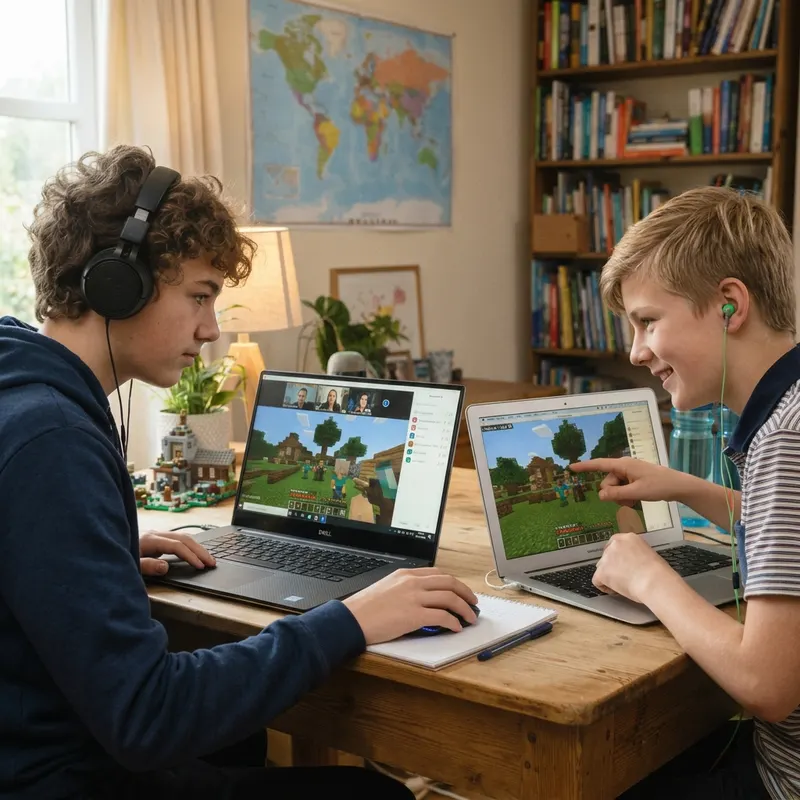
Code your own world
Block-based coding and logic inside Minecraft Education.
See curriculum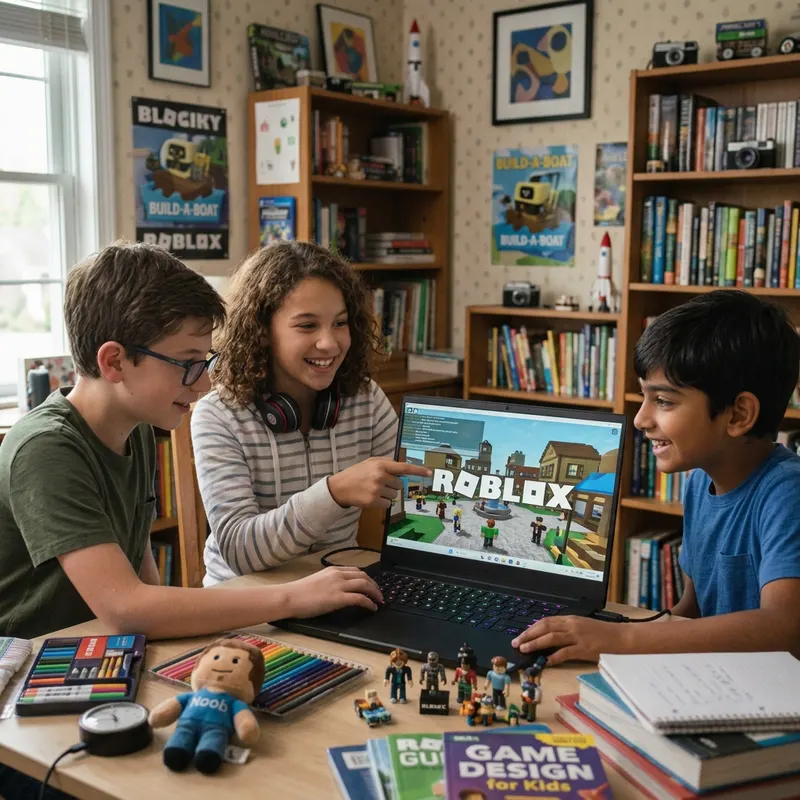
Build and publish your video game
3D video game design and programming in Roblox Studio with Lua, a real programming language.
See curriculum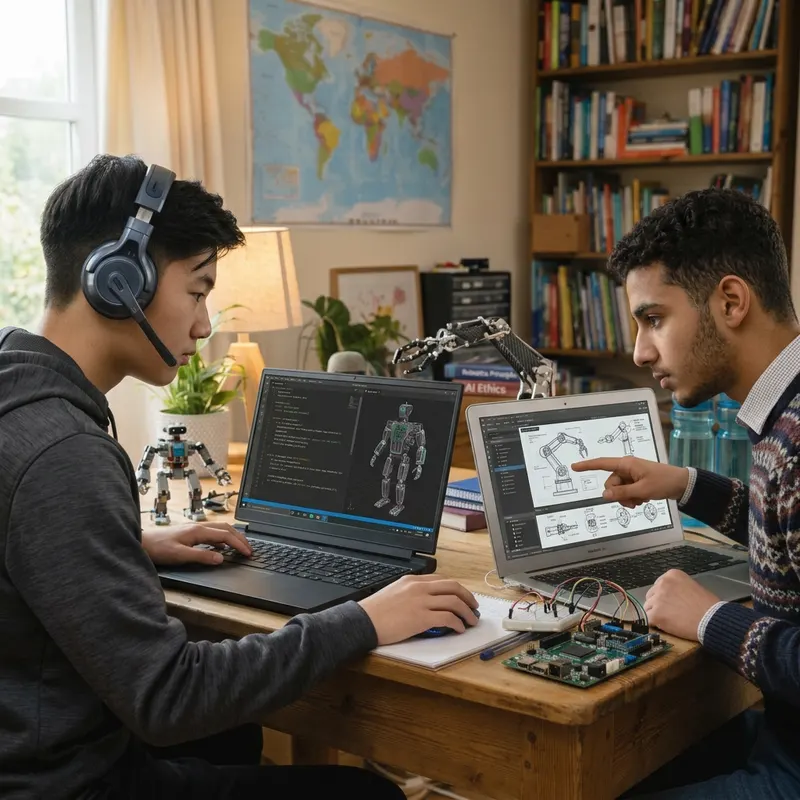
Build apps, chatbots and projects
Go from using AI to building with it.
See curriculumImages, video and viral content
Professional content creation with artificial intelligence: design, copywriting, voice, short video and social media strategy.
See curriculumHow we teach
Every class ends with something the student has built.
Week 7 is for presenting to families, a jury or an audience.
Parental controls, age-appropriate tools and digital citizenship rules.
Logic and math built into every course.
What each course includes